How to Pass the Series 7 Exam in 2026
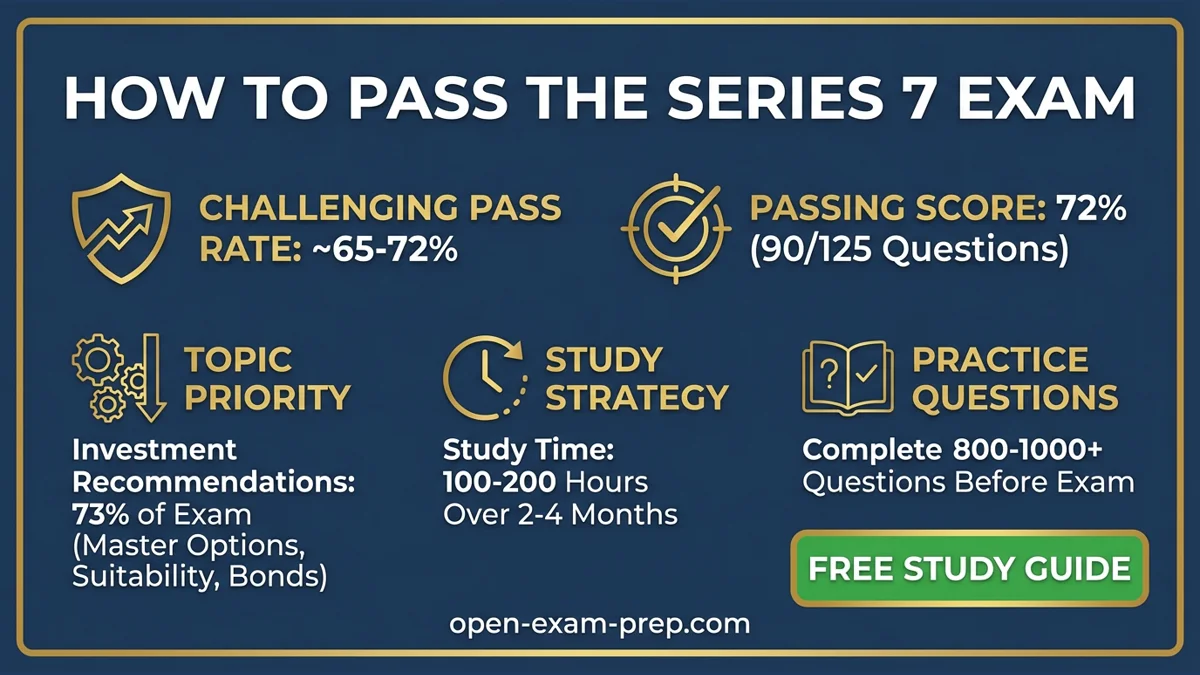
The Series 7 exam, administered by FINRA, has a 65-72% pass rate, making it one of the most challenging securities exams. But with the right preparation strategy, you can pass on your first attempt.
This comprehensive guide shares the proven strategies used by successful candidates - from mastering options to managing the 3 hour 45 minute exam marathon.
free Series 7 practice questionsPractice questions with detailed explanations
Series 7 Exam Overview
| Detail | Information |
|---|---|
| Total Questions | 125 scored + 10 unscored = 135 total |
| Passing Score | 72% (90 out of 125 correct) |
| Time Limit | 3 hours 45 minutes (225 minutes) |
| Exam Fee | $245 |
| Prerequisites | SIE exam + firm sponsorship |
| Pass Rate | 65-72% |
| Retake Wait | 30 days (first 2 attempts), 180 days after 3rd |
The Series 7 Content Breakdown
Understanding the exam weights helps you prioritize your study time:
| Section | Weight | What It Covers |
|---|---|---|
| Investment Recommendations | 73% | All securities, suitability, options, bonds, strategies |
| Opening Customer Accounts | 11% | Account types, documentation, transfers |
| Seeking Business | 9% | Communications, advertising, referrals |
| Processing Transactions | 7% | Settlement, execution, confirmations |
Key Insight: Nearly 3/4 of your exam score comes from "Investment Recommendations." This section covers options, bonds, suitability, and investment strategies - your primary study focus.
8 Strategies to Pass the Series 7
Strategy 1: Master Options First (They Make or Break Your Score)
Options are the most heavily tested and most failed topic on the Series 7. Master these before anything else:
The Four Basic Positions:
| Position | Market View | Max Gain | Max Loss | Breakeven |
|---|---|---|---|---|
| Long Call | Bullish | Unlimited | Premium paid | Strike + Premium |
| Short Call | Bearish | Premium received | Unlimited | Strike + Premium |
| Long Put | Bearish | Strike - Premium | Premium paid | Strike - Premium |
| Short Put | Bullish | Premium received | Strike - Premium | Strike - Premium |
Must-Know Strategies:
- Covered Call: Long stock + Short call (income strategy)
- Protective Put: Long stock + Long put (insurance)
- Bull Call Spread: Long lower strike call + Short higher strike call
- Bear Put Spread: Long higher strike put + Short lower strike put
- Straddle: Long call + Long put (same strike, same expiration)
Options Study Plan:
- Week 1-2: Master the four basic positions
- Week 3: Learn covered calls and protective puts
- Week 4: Master spreads (bull, bear, debit, credit)
- Week 5+: Practice straddles, combinations, and mixed questions
Strategy 2: Conquer Bond Calculations
Bonds are the second-most challenging topic. Know these calculations:
Essential Bond Formulas:
| Calculation | Formula |
|---|---|
| Current Yield | $\frac{\text{Annual Interest}}{\text{Market Price}}$ |
| Yield to Maturity | $\frac{\text{Annual Interest} + \text{Annual Gain/Loss}}{\text{Average Price}}$ (approximation) |
| Accrued Interest | $\frac{\text{Days since last payment}}{\text{Days in period}} \times \text{Semi-annual interest}$ |
Bond Price Relationships:
- When interest rates go UP, bond prices go DOWN
- When interest rates go DOWN, bond prices go UP
- Premium bonds trade ABOVE par (coupon > market rate)
- Discount bonds trade BELOW par (coupon < market rate)
Bond Types to Know:
- Corporate bonds (taxable)
- Municipal bonds (tax-exempt for federal, often state)
- Government securities (T-bills, T-notes, T-bonds)
- Agency securities (GNMA, FNMA, FHLMC)
Strategy 3: Follow the 800-Question Rule
Successful Series 7 candidates complete 800-1000 practice questions. Here's a structured approach:
| Week | Questions | Focus Area |
|---|---|---|
| Week 1-2 | 200 | Options basics |
| Week 3-4 | 150 | Bonds and debt securities |
| Week 5-6 | 150 | Equity securities, mutual funds |
| Week 7-8 | 100 | Customer accounts, suitability |
| Week 9-10 | 100 | Municipal securities, regulations |
| Week 11-12 | 200+ | Full practice exams (mixed) |
Quality Matters: Don't just answer questions - analyze every wrong answer. Ask yourself:
- What concept did I misunderstand?
- What trap did I fall into?
- How would I recognize this question type again?
AI Study AssistantPractice questions with detailed explanations
Strategy 4: Study Suitability Systematically
Suitability questions test your judgment. Learn the framework:
Customer Profile Factors:
- Age and time horizon
- Risk tolerance (conservative, moderate, aggressive)
- Income and net worth
- Tax bracket
- Investment objectives (income, growth, preservation)
- Liquidity needs
Investment Matching:
| Customer Type | Suitable Investments | Unsuitable Investments |
|---|---|---|
| Conservative/Retired | Bonds, CDs, money market, blue chips | Options, penny stocks, high-yield bonds |
| Moderate/Middle-aged | Balanced funds, blue chips, investment-grade bonds | Speculative stocks, futures |
| Aggressive/Young | Growth stocks, sector funds, some options | Beyond their understanding |
Key Suitability Rules:
- Never recommend penny stocks to conservatives
- Match investment time horizon to customer goals
- Consider concentration risk
- Always consider tax implications
Strategy 5: Create a 12-Week Study Schedule
The Series 7 requires sustained effort. Here's a proven timeline:
Weeks 1-4: Build the Foundation
- Learn options (2 weeks intensive)
- Learn bonds and debt securities
- Complete 300+ practice questions
Weeks 5-8: Expand Your Knowledge
- Equity securities and analysis
- Mutual funds and ETFs
- Customer accounts and margin
- Municipal securities
- Complete 300+ more questions
Weeks 9-10: Fill the Gaps
- Regulations and compliance
- Processing transactions
- Weak area review
- Complete 200+ questions
Weeks 11-12: Exam Simulation
- Take 5+ full practice exams
- Score 80%+ before scheduling
- Final review of weak areas
Daily Schedule (2-3 hours):
- 45 min: New material (reading/video)
- 45 min: Practice questions on today's topic
- 30 min: Review yesterday's wrong answers
- 15 min: Quick review of flashcards/key terms
Strategy 6: Know the Municipal Securities Rules
Municipal securities have unique rules that are frequently tested:
Key Muni Concepts:
- GO Bonds: Backed by taxing power (general obligation)
- Revenue Bonds: Backed by project revenue (tolls, fees)
- Tax Exemption: Federal income tax (most), state tax (if same state)
- De Minimis Rule: Discount treated as ordinary income if > market discount threshold
- AMT: Some private activity bonds subject to Alternative Minimum Tax
MSRB Rules to Know:
- G-17: Fair dealing with customers
- G-19: Suitability requirements
- G-37: Political contribution rules
- G-32: Disclosures to customers
Strategy 7: Master Margin Account Calculations
Margin questions require quick math under pressure:
Key Margin Formulas:
| Calculation | Formula |
|---|---|
| Reg T Initial Requirement | $50%$ of purchase price |
| Long Margin Maintenance | $25%$ of market value |
| Short Margin Maintenance | $30%$ of market value |
| Equity | $\text{Market Value} - \text{Debit Balance}$ |
| SMA (Special Memorandum Account) | Excess equity above Reg T |
Margin Calculation Tips:
- Always start with current market value
- Calculate required equity (maintenance)
- Compare to actual equity
- Determine if margin call is needed
Strategy 8: Manage the 3 Hour 45 Minute Marathon
The Series 7 is an endurance test. Prepare accordingly:
Time Management Strategy:
- 225 minutes / 125 questions = 1.8 minutes per question
- Target pace: 30 questions per hour
- Build in 15 minutes for review at the end
Checkpoints:
- Question 30: Should be at ~54 minutes
- Question 60: Should be at ~108 minutes
- Question 90: Should be at ~162 minutes
- Question 125: Should finish by ~210 minutes
Stamina Building:
- Take timed practice exams (all 125 questions)
- Practice in 90-minute sessions
- Build up to full-length practice exams in Week 10+
The Hardest Series 7 Topics (and How to Beat Them)
Options Strategies
Why it's hard: Multiple moving parts, calculations under pressure How to beat it: Use the T-chart method, memorize formulas, practice 200+ options questions
Bond Yield Calculations
Why it's hard: Multiple yield types, inverse relationships How to beat it: Learn the formulas, practice calculations, understand the conceptual relationships
Municipal Securities
Why it's hard: Unique tax rules, many acronyms How to beat it: Create a muni cheat sheet, focus on GO vs. Revenue, know the tax implications
Suitability
Why it's hard: Subjective judgment required How to beat it: Think like a compliance officer - what's the safest recommendation for THIS customer?
Margin Calculations
Why it's hard: Multi-step calculations under time pressure How to beat it: Practice the step-by-step method, work through 50+ margin problems
Series 7 Exam Day Tips
Before the Exam
- Arrive 30 minutes early
- Bring two forms of ID (one government-issued with photo)
- Light breakfast - avoid heavy foods
- Quick formula review in the car
- Use the restroom before checking in
During the Exam
- Read each question completely - watch for "NOT" and "EXCEPT"
- For calculation questions, write down your work
- Flag difficult questions and return later
- Take a brief mental break every 45 minutes (deep breaths, stretch)
- Never leave a question blank - there's no guessing penalty
Answer Strategy
- Eliminate obviously wrong answers first
- For suitability questions, think "what's safest for this customer?"
- For calculation questions, estimate first to check reasonableness
- Trust your first instinct - change only if you misread
What If You Fail?
If you don't pass on your first attempt:
- Review your score report - Identify weak topic areas
- Wait the required 30 days - Use this time productively
- Change your approach - More practice questions, different study materials
- Consider a structured course - If you self-studied, add guidance
- Target 85%+ on practice exams - Give yourself a bigger buffer
- Talk to your firm - They want you to pass and may offer additional support
Remember: Many successful financial professionals didn't pass on their first attempt. Persistence matters.
Start Your Series 7 Preparation
Ready to tackle the Series 7? Here's how to get started:
Free Series 7 Practice Questions
- 800+ exam-style questions covering all exam sections
- Detailed explanations for every answer
- AI tutor to explain complex options strategies and bond calculations
- Progress tracking by topic area
More Series 7 Resources
- Series 7 Pass Rate 2026 - Understand the statistics
- Series 7 Exam Day Guide - What to expect on test day
- SIE vs Series 7 - Understand the differences
- Financial Terms Glossary - Master key vocabulary
Need the SIE First?
The Series 7 requires passing the SIE exam. If you haven't taken the SIE yet:
Key Takeaways
- Options are everything - Master them first, they make or break your score
- 800+ questions - Quality practice is the best predictor of success
- 80% rule - Score 80%+ on practice exams before scheduling
- 12-week plan - Give yourself time to truly learn the material
- Endurance matters - Practice full-length exams to build stamina
The Series 7 is challenging but absolutely passable. With dedicated preparation and the right strategy, you'll join the 65-72% who succeed.
Good luck with your Series 7 exam!
 Buy on Amazon
 Practice exams on ExamEdge
 Take courses on Udemy
 Online course on Mometrix