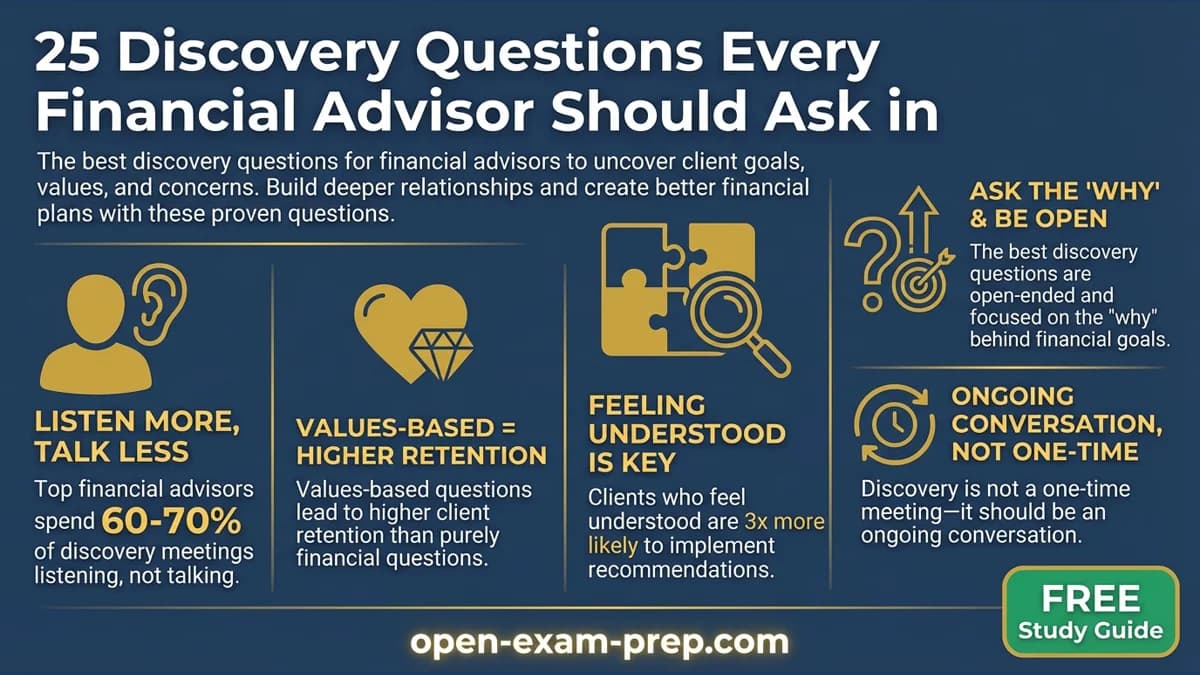
Why Discovery Questions Matter
The discovery meeting is the foundation of every client relationship. Ask the wrong questions and you'll build a plan on incomplete information. Ask the right questions and you'll uncover what clients really want—often things they hadn't fully articulated themselves.
Key insight: The best financial advisors spend 60-70% of discovery meetings listening. Your questions create space for clients to talk.
Great discovery questions do three things:
- Uncover the "why" behind financial goals
- Build trust through genuine curiosity
- Create differentiation from advisors who only ask about numbers
The Discovery Question Framework
Organize your questions into five categories:
| Category | Purpose | Example |
|---|---|---|
| Opening | Build rapport, understand context | "What prompted you to meet today?" |
| Goals | Clarify what they want to achieve | "What does retirement look like to you?" |
| Values | Understand what matters most | "What's important about money to you?" |
| Concerns | Identify fears and obstacles | "What keeps you up at night financially?" |
| Experience | Learn from their past | "What has your experience with advisors been like?" |
25 Essential Discovery Questions
Opening Questions (Setting the Stage)
1. "What prompted you to reach out? Why now?"
This question reveals what's driving their decision to seek advice. The answer often contains their most pressing concern.
Listen for: Life changes (divorce, inheritance, job change), dissatisfaction with current situation, specific trigger events.
2. "What are you hoping to accomplish in our time together today?"
Sets expectations for the meeting and ensures you address their priorities.
Listen for: Whether they want education, validation, a second opinion, or a specific problem solved.
3. "What would make this meeting a success for you?"
Similar to question 2, but frames it in terms of outcomes. Some clients find this easier to answer.
Listen for: Concrete deliverables vs. emotional needs (feeling understood, having a plan).
Goals & Vision Questions
4. "If money were no longer an issue, what would your life look like?"
This removes constraints and reveals true aspirations—often surprising ones.
Listen for: What excites them, what they'd do differently, what they're postponing.
5. "Fast forward one year—what has happened that tells you working together was a success?"
Creates a concrete vision of success and reveals their priorities.
Listen for: Specific outcomes, feelings they want to have, problems they want solved.
6. "What does retirement mean to you? What will you do in retirement?"
Many clients haven't thought beyond "stop working." This question uncovers what they're retiring to.
Listen for: Activities, travel, family time, second careers, legacy projects, concerns about purpose.
7. "What are the three most important things you want your money to do for you?"
Forces prioritization. The order matters—their first answer is usually most important.
Listen for: Security, lifestyle, family, giving, experiences, legacy.
8. "Are there any dreams or goals you've put on hold?"
Uncovers deferred aspirations that good planning might make possible.
Listen for: Things they've dismissed as "unrealistic" that might actually be achievable.
Values & Priorities Questions
9. "What's important about money to you?"
The classic values question. Keep asking "and what's important about that?" to go deeper.
Example dialogue:
- Client: "Security."
- You: "What's important about security to you?"
- Client: "Knowing my family will be okay."
- You: "And what's important about that?"
- Client: "I grew up without much and I never want my kids to feel that uncertainty."
Listen for: Core values that drive financial behavior.
📘 Master the discovery conversation. Our free Client Conversations Mastery course teaches you how to ask these questions naturally and handle any response.
10. "How do you and your spouse/partner approach money decisions?"
Reveals relationship dynamics that affect financial planning.
Listen for: Alignment or tension, who handles what, decision-making process.
11. "What family financial experiences shaped how you think about money today?"
Past experiences often create present beliefs—some helpful, some limiting.
Listen for: Stories about parents' money struggles, windfalls, losses, lessons learned.
12. "Who are you financially responsible for? Who is it important that you're able to help?"
Goes beyond "do you have dependents" to understand family priorities.
Listen for: Children, parents, extended family, charitable causes.
13. "What would you never want to happen with your money?"
Reveals fears and non-negotiables. Sometimes easier to answer than positive goals.
Listen for: Running out of money, losing independence, burdening family, leaving loved ones unprotected.
Concerns & Challenges Questions
14. "What keeps you up at night when it comes to your finances?"
Direct question about worries. The phrase "keeps you up at night" often unlocks emotional answers.
Listen for: Specific fears, general anxiety, knowledge gaps.
15. "What's the biggest financial decision you're facing right now?"
Identifies pressing issues that need immediate attention.
Listen for: Urgency, complexity, what's preventing them from deciding.
16. "What obstacles do you see between where you are now and where you want to be?"
Surfaces real and perceived barriers to their goals.
Listen for: Concrete obstacles (debt, income) vs. mindset barriers (fear, lack of knowledge).
17. "Is there anything about your current financial situation you're not happy with?"
Invitation to share dissatisfaction or frustration.
Listen for: Specific pain points, missed opportunities, regrets.
18. "What's the biggest financial mistake you've made, and what did you learn from it?"
Reveals risk tolerance, self-awareness, and potential blind spots.
Listen for: How they talk about mistakes—do they learn or blame?
Experience & Expectations Questions
19. "Have you worked with a financial advisor before? What did you like or dislike about that experience?"
Tells you what to do more of and what to avoid.
Listen for: Positive experiences to emulate, pain points to address, reasons for leaving.
20. "How do you prefer to communicate? How often do you want to hear from me?"
Sets expectations early and shows you care about their preferences.
Listen for: Email vs. phone vs. in-person, frequency expectations.
21. "Who else should be involved in our financial planning conversations?"
Identifies stakeholders—spouses, adult children, attorneys, CPAs.
Listen for: Family dynamics, other advisors to coordinate with.
22. "How do you make important decisions? What does your process look like?"
Helps you understand their decision-making style so you can work with it.
Listen for: Fast vs. slow, research-heavy, consensus-seeking.
Closing Questions
23. "What questions do you have for me?"
Shows you value their input and surfaces unstated concerns.
Listen for: What they're evaluating you on, what matters to them.
24. "Is there anything we haven't covered that you feel is important for me to know?"
Catches anything they wanted to share but didn't find the right moment.
Listen for: Often reveals the most important information.
25. "On a scale of 1-10, how confident do you feel about your current financial situation?"
Quantifies their starting point and can be tracked over time.
Follow up with: "What would make it a 10?"
Best Practices for Discovery Meetings
Before the Meeting
- Send a brief fact-finding questionnaire (income, assets, debts)
- Research their background (LinkedIn, company, industry)
- Prepare 8-10 tailored questions based on their situation
- Set up a comfortable meeting environment
During the Meeting
- Listen more than you talk (aim for 70/30)
- Ask one question at a time (don't stack questions)
- Take notes (ask permission first)
- Use silence (let them think and elaborate)
- Summarize what you hear ("So what I'm hearing is...")
After the Meeting
- Send a summary email within 24 hours
- Note key insights in your CRM
- Identify 2-3 priority areas to address first
- Plan your follow-up and next steps
Questions to Avoid
| ❌ Avoid | ✅ Instead |
|---|---|
| "What's your net worth?" (too early) | "Can you give me a general picture of your financial situation?" |
| "What are your financial goals?" (too vague) | "What does success look like for you in the next 5 years?" |
| "Are you worried about retirement?" (yes/no) | "How do you feel about your retirement readiness?" |
| Multiple questions at once | One question, wait for full answer |
| Interrupting to share your expertise | "Tell me more about that" |
Discovery Beyond the First Meeting
Great discovery never ends. Weave these questions into ongoing conversations:
| Annual Reviews | Life Events | Regular Check-ins |
|---|---|---|
| "What's changed since we last met?" | "How are you feeling about this transition?" | "What's top of mind for you right now?" |
| "What are you most proud of this year?" | "What support do you need?" | "Any new concerns I should know about?" |
| "What's one thing you'd do differently?" | "How does this change your priorities?" | "What's going well?" |
Practice Your Discovery Skills
Reading about questions isn't enough—you need to practice asking them naturally.
Our Client Conversations Mastery course includes:
- Discovery question frameworks with roleplay practice
- AI-powered conversation simulations for realistic practice
- Handling difficult responses when clients give unexpected answers
- Building rapport techniques that make clients comfortable opening up
Quick Reference: Top 10 Must-Ask Questions
If you only have 30 minutes, ask these:
- What prompted you to reach out? Why now?
- What would make this meeting a success for you?
- What's important about money to you?
- What does retirement/financial success look like for you?
- What keeps you up at night financially?
- What's the biggest financial decision you're facing?
- What has your experience with advisors been like?
- Who else should be involved in our conversations?
- How do you prefer to communicate?
- What questions do you have for me?
The Bottom Line
The quality of your client relationships depends on the quality of your questions.
Clients don't remember exactly what you told them about asset allocation. They remember how you made them feel—whether you truly understood them, their hopes, and their fears.
Master these 25 questions, and you'll build the kind of deep client relationships that lead to trust, retention, and referrals.
Start with your next client meeting. Pick 3-5 new questions from this list and see how they change the conversation.

 Buy on Amazon
 Prep course on Achievable
 Take courses on Udemy
 Online course on Mometrix
 Practice exams on ExamEdge
